Thursday, September 9, 2010

A nod to smitten kitchen

Oh my goodness.  Now THIS is the way to use fresh, local peaches.  I'm not kidding, people.  Try this recipe.

Thanks to smitten kitchen for weekly inspiration! http://smittenkitchen.com/2010/09/peach-shortbread/

Saturday, September 4, 2010

Good fences . . . .

Okay, people, you all know about the importance of barriers - condoms, dental dams, 3 feet of personal space - but I'm here today to talk about pest barriers.  That's right:  pests.
Mule deer:  lovely to some, pestilence to others.
There are many challenges to gardening here, including low soil fertility, high winds, low temperatures, early and late frosts, and PESTS.  Where I live, pests burrow underground, browse on four long legs, and fly through the air.  They are a gardener's bane in the Methow Valley.  Here are a few simple (not easy), and cheap (not free) pest barriers which I have made use of in my garden.

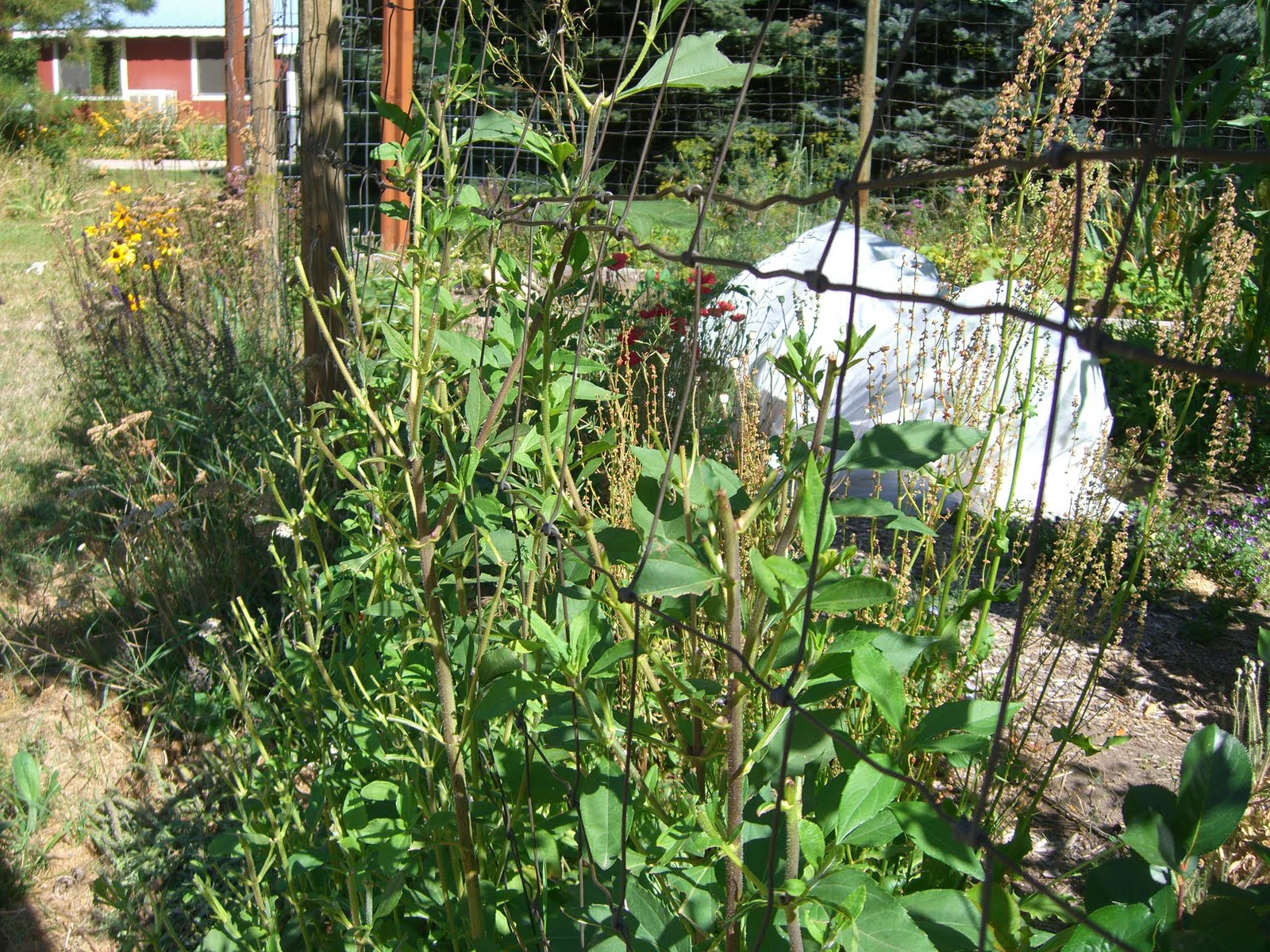
The first is a fence.  I know, I know, it sounds obvious, right?  However, many people who first get into gardening around here try to get by for a while without one.  (You know who you are.)  This has only led to heartache and grief.  Unless you are really in to planting things and then watching them get destroyed by our four-legged browsers, JUST BUILD A FENCE.  I mean a good one.  Seven feet high with sturdy posts sunk 3 feet into the earth.  Trust me, people.  I know what I'm talking about.
These Jerusalem artichokes grow right along the fence line and the deer keep them "nicely" pruned.
Another useful arrow to have in your deer-proofing quiver is the tree cage.  These can be erected around a single tree or clusters of trees and shrubs.  They are not pretty.  I really wish I didn't have to use them.  However, after suffering depressing losses due to browsing and antler-rubbing (did you know a deer will strip a tree of its bark by rubbing its antlers on it?), I am now resigned to caging some trees.  We make a simple cylinder of  60" wire fencing supported by 4-foot lengths of rebar driven into the ground.  It's best to raise the base of the cage about a foot off the ground to enable weeding and grass clipping. 

A tree cage doing its job around a cluster of young trees and shrubs.
Within the garden fence, I've devised some simple pest barriers as well.  A couple of them protect my berries from snacking birds.  Mylar ribbons hanging from the raspberry wires (I stapled them on), are really bright, and scare birds away.  I'm going to use them next year in my cherry tree as well.
Light-weight wire hoops are stuck in the ground over my strawberry rows.  During berry season, I drape bird netting over the wire and secure it to the ground with "earth staples" or fist-sized stones.  We get to eat all the berries this way.
Baby greens
In early spring and late fall, I use PVC hoops covered with a frost-protective fabric to extend the season in my garden beds.  This year I'm using this same system to protect my "baby" lettuce and spinach from the hordes of grasshoppers.   

In August, it's nearly impossible to start a fall crop of greens, due to both the high temperatures and the munching 'hoppers.  The breathable garden fabric facilitates seed starting in two ways:  by shading the bed somewhat it lowers the soil temperature and decreases the evaporation rate, and it keeps out the insects.

Finally, pocket gophers are native to the Methow Valley.  Laurelle's garden is adjacent to a giant grassy field which hosts a stable population of the rodents.  There's nothing we can do about this.  Gophers will eat the roots of bean plants, and they LOVE garlic, potatoes, and carrots.  I have underlaid some of my beds with small-gauge chicken wire, back-filled with around 8 inches of soil, and plant right over it.  Eventually, I'll probably have most of the garden beds protected from subterranean munchers.
You can just see some chicken wire to the lower right in this photo.

Fruits of the earth

Rhubarb chard
I want to show off some garden photos I shot just now.  Note this produce has not been harvested yet, and some is not quite ready but as long as this beautiful weather holds . . . .
Snack-R-Jack pumpkin (hull-less seeds)

Arava melon

Lipstick pepper
Venus grape

Tuesday, August 24, 2010

My biggest fan

Me, not eating well
I often don't eat well when I'm home alone.  Or maybe I should say, I eat weird.  I'll subsist on coffee until mid-morning at which time I frantically re-heat and gulp down some leftover pasta.  Then I'll forget to eat again until late afternoon at which time I'll slurp down an iced mocha while making a gigantic salad to eat at one sitting.  Or I'll make a meal out of a baked sweet potato.  If I'm feeling emotional, (are you ready for this?) Spagettios may make an appearance in my kitchen.  I pretty much forgo "regular" mealtimes, and just eat when I get hungry.

Axiom #4: You'll eat better if you have someone to cook for.

Which brings me to my biggest fan, Frank Vander Wall.  Here he is, enjoying a turkey and tomato sandwich at our "normal" lunch hour.

Frank, eating well


You see, when Frank and I are home together for lunch, I actually prepare food and we sit down and eat it together.  Same goes for breakfast and dinner. Three meals a day at "regular" times.  I know what you're thinking: this makes me sound totally conventional and house-wifey, but get over it, people.

My sweetheart brings out many of my better traits. Cooking well and 3 squares are just a couple of them.  Many thanks to my biggest fan!
A New Zealand luncheon

Thursday, August 19, 2010

Saving seeds

Blunt About Food is ideally a blog about my two avocations:  cooking and gardening.  This post will introduce you to the latter of those two passions, and hopefully shed some light on who I am.

I've been a seed saver and gardener since I first interned at Abundant Life in 1991.  But well before that, I studied ethnobotany at Evergreen and decided, "That makes a lot of sense".  Even before that, I came to the conclusion that if all hell broke loose, I'd want at least to be able to grow my own food.

I inherited the gardening gene big time.  There are many in my extended family who tend a garden, but according to my parents, there are a handful of us who are UNABLE TO KEEP OUR HANDS OUT OF THE DIRT.  This is not a hobby, people.  It is an integral part of who I am.

My cousin, Dan Quickert, shares this trait.  He has been an avid organic gardener for decades, and has quite admirably done a bit of plant breeding along the way.  Last spring, he sent me about 40 seeds of a purple-podded snow pea he developed and named "Midnight Snow".

Here are some fresh results of what grew from those seeds.

Midnight Snow Pea
The pea vines were crazy vigorous - reaching 7 feet tall before they started producing their lovely violet blossoms.  The pods were sweet and abundant; however, I was on a mission to save seeds and so I limited my edible harvest to what's in the photo.  The rest kept growing until the vines stopped sending energy to the pods and began to yellow.

With the help of Lisa (who was visiting from San Diego), I harvested the already-dying pea vines, and laid them on wire racks to finish developing and drying the pea seeds.

Tonight I shelled all the peas, and this is what I got:

Pea seeds ready for planting next spring
These seeds weigh 20 ounces, and 40 seeds equal 1/4 ounce, so my efforts were rewarded 80-fold!  I feel wonderful about this success.  I will send the majority back to Dan, and keep some for myself to grow next year.

There is something special about saving seeds.  It requires sacrifice; with most crops, saving seed means you won't be eating that fruit or vegetable.  It requires vision; you must think early about which plants you'll be saving for seed and designate them to that task.  It requires optimism; you are doing this for future gardens.  These are qualities I don't mind developing in myself as well.

Wednesday, August 11, 2010

Simplify!

This post will be brief - this is the summer of houseguests!

Axiom #3:  Fewer ingredients is always better, people.


It's kind of like a rule of good dressing I heard once - put on your clothes, jewelry, etc. and then remove one item.  (For some people it may be more like 2 or 3 items).  But you get the idea.  Less is more.

So.  If you have luscious, fresh cherry tomatoes out of the garden, highlight them in your recipe with just a few other ingredients.  Toss those little lovelies in that fresh pasta, use some garlic, olive oil, and crushed red pepper, and then STOP.  Resist the temptation to add the feta and parmesan, and chicken and, and, and. . . .

Of course, there's room in this world for complicated sauces, curries, jambalaya, etc., but really, they've already been invented.  And of course, if your ingredients are not fresh and wonderful you may have to cover them up a bit, but that's a whole other topic (and problem) entirely.

So here's to simple cooking!


Monday, August 9, 2010

I do sourdough.

I don't eat a lot of bread, but when I do, I really prefer a dense, sour loaf.  No surprise when I read that most commercial sourdough breads were actually "sour enhanced" through the addition of citric acid or some damn thing.


That's when I started playing around with sourdough.


Axiom #2:  Sourdough IS NOT rocket science. Ignore all the crap you read on the web about weighing your flour and water and getting your starter from someone's great grandmother.  It's really simple, people.


. . . just feed it once in a while
Sourdough is just a bunch of yeastie-beasties that naturally exist in our environment (like on that lovely, fresh, local wheat flour which you bought at the farmer's market), and would happily reproduce at room temperature with the addition of some water.


Sponge after 9 hours - NO added yeast


Okay, so I'm not going to go into a whole lesson on baking with sourdough here.  I'd have to charge money for that.  (Hey, that's not a bad idea . . . .)  And I'm really not a purist.  I will use a little commercial yeast to get a higher loaf or speed up the process.

Oh yeah, and there's sourdough pancakes (OH YUM) to cover another time.  Definitely superior to any other sort of pancake.

Here's some bread.

A really nice, crusty, dense, sour loaf.