Showing posts with label natural history. Show all posts

Tuesday, June 14, 2011

Natural history encounter #2

So here's the other thing I've been meaning to tell you about.

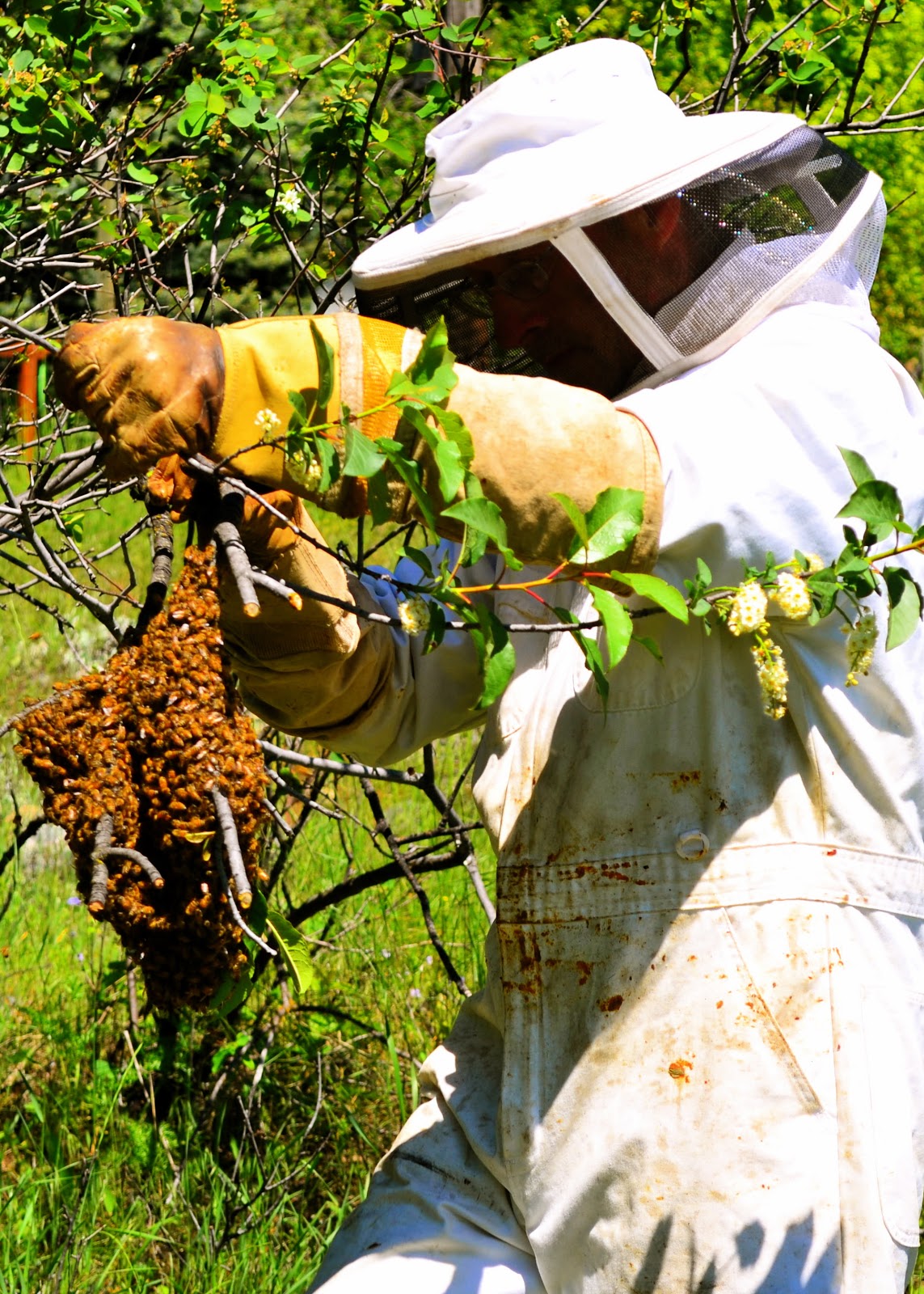
I was out working in the garden and had stopped to straighten my back and enjoy the view, when I noticed a strange, solid, football-sized shape in a chokecherry bush in our field. I had a hunch what it was, but I wanted to be sure . . . .
Yup, I thought so.

Here; let's get a little closer.

So, honeybees are awesome in so many ways. Without them we basically wouldn't have agriculture. Well, I guess if we wanted to limit our diets to lentils and wheat, but you like apples and nectarines and zucchini - stuff like that, right? Gotta have bees.

Honey's good, too.

So I called local bee keeper and all-around-great guy, Dave Sabold, and asked him what these bees would do if left alone. He said they'd either find a hollow tree to move into, or the walls of our house. Repeat: the walls of our house. I told him to come on over with a hive box and get them.
Dave's supplies - those are gloves.
By the time Dave arrived, Frank and I were already feeling kind of attached to the little buzzers, so we asked about leaving the bee hive (after they move into the box) on our property. I mean, we have apple trees and a garden and an enormous alfalfa field next door. Well, Dave explained that bears love nothing more than a bee hive - we knew that, right - and we'd have to put it inside a sturdy fence or on top of a flat roof. No flat roof here, and the only fence is my now-looking-very-small garden, so we decided to let Dave take them.

Dave is excited to get wild bees because they've survived the Methow winter without added food, so they should be more cold-hardy and resilient than imported bees. He would like to get a "Methow strain" going - pretty cool, huh?
Dave suiting up. Swarm in chokecherry bush. Hive box at his feet.
Dave pruned the branches around the swarm and removed the mass by hand.

Gently lowering the branch and bees onto the hive box.
The bees are now entering their new home.
Dave put a lid on the box and left them for a couple of days to make sure that the whole hive moved in. He came and carried them away at dusk when he knew they all would be tucked in to bed for the night.

The bees are now part of Dave and Marilyn's home honey and skin salve business, Gardner Gardens.

Wednesday, June 8, 2011

Natural history encounter #1

We live closer to nature here in the Methow than most people do in most places.

This fact becomes obvious at times, and rarely more so than during this last week. (Spoken in slow country twang.)  We have had us some nature, folks: up close and personal.

On Saturday morning, our nearest neighbor Joanne phoned and said that she was watching a doe with two newborn fawns under her willow tree. I sneaked over there with my new Nikon and the following photos depict some of the morning's adventure. (Keep reading . . . .)
If you look carefully, you can see #2 fawn's ears on left.
#1 is up and ready to go.
Bath time.


Mom and baby #1 have now moved to the opposite side of the big willow tree from baby #2. I'm wondering if baby #2 is going to stand up.

So I go over to where baby #2 is lying very still.
 It responds to my presence, as you can see.
From here, the photos end. You see, baby #2 rises from the ground and decides to imprint on my legs. It sticks right next to me, wobblingly following me as I move slowly toward mom, who is around 100 feet away. As baby #2 and I walk out of the shade of large willow, I make soft deer sounds (yes, they call to their babes). Mom figures out what's going on and doesn't like it ONE BIT. She charges me; I have at my disposal a fist, a brand-new camera, and neighbor Joanne - hero of the day - who distracts the doe from across the yard. I am able to exit the scene; doe runs frantically between her two babies; eventually the family is reunited. I don't have pictures of that part because my hands were shaking.

Monday, October 11, 2010

Nature as gambler

Fall colors in the Pasayten
In my last post, "Gardener as gambler", I was thinking about how I hedge my bets in the garden, watching the weather forecast, harvesting some produce while risking the loss of some to eke out the last golden days of Indian summer.

Living here in the Methow Valley, the observant human witnesses natural gambling in every season.  I know from studying natural history, that in every population of plants, insects, and animals, there exist outliers - those individuals who push the envelope just a little by reproducing or migrating earlier or later in the season, or expanding into new territory.

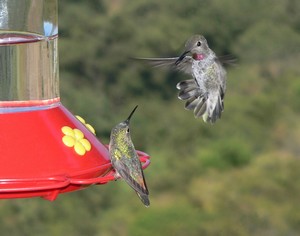
Photo from Birdwatching-bliss.com
Hummingbirds are one obvious example.  They move up the valley each spring, gaining elevation, probably following the blooming willows and wild currants.  What benefits do the early comers derive?  Nights often drop below freezing when I observe my first hummer in April, and I rush to put out a hummingbird feeder to provide calories to the cold little gamblers.  Every fall I'm sure all the hummers have headed south and I'm ready to take down the feeder when one little guy will show up for another drink.  I had a visitor to the feeder at breakfast today, October 11.  "Fly south you little knucklehead!"


There are A LOT of mule deer here.  Our property is on the East Chewuch "deer highway" which connects the town deer (yes, that's what we call them) with the good foraging up river.  I won't share my thoughts on the deer population with you today, just know that they are doing VERY WELL.  

Mule deer youth in our front yard.
We observe our first spotted fawn each year in May or June.  This year I'm pretty sure that one doe produced triplets, but I don't know if all three survived.  Each year in the fall, we notice that some of the first-year fawns are noticeably less robust than their peers.  They were probably born later.  I actually say to them, "Eat up, winter's coming", because once snow lies and there's nothing green to eat, those little guys will begin  to starve.  They must survive off whatever fat they've managed to store up in their first summer of life.  Here's the hard part.  Every winter, Frank and I haul frozen yearling mule deer carcasses off the property after the lethal nights of the cold moon (January) and the hunger moon (February).

Frank in "the tube" sliding off the porch roof.
Every winter there's a thaw period, sometimes accompanied by the "Pineapple Express", a warm wind that blows out of the Pacific Ocean.  Daytime and nighttime temperatures may stay above freezing for a week or more, snow slides off the roof, and we'll actually have puddles of meltwater on the driveway.  Guess who shows up about then?  Mosquitoes.  That's right, every winter some number of mosquitoes hatch out during the thaw, only to perish before reproducing.  It's a gamble that must pay off some years, to be that first mosquito to hatch out in the spring.

Asparagus on May 5