Wednesday, August 8, 2012

Rapt for raptors


Last night (Aug. 7) Frank and I and perhaps 200 other folks enjoyed the Methow Conservancy's First Tuesday program on a warm evening in Winthrop's Mack Lloyd Park.

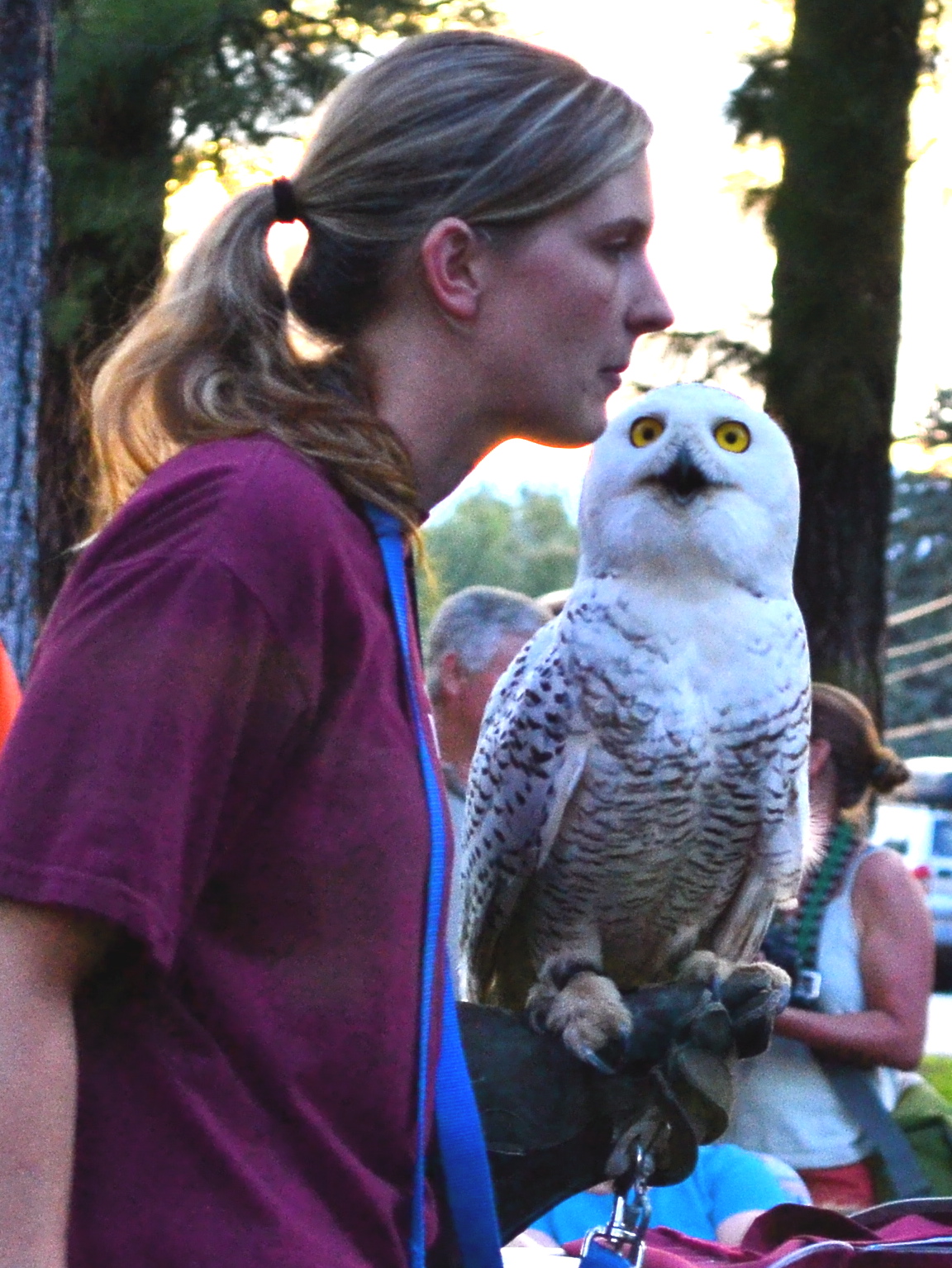
Jessica Graham from Washington State University's Raptor Club brought three beautiful live raptors all the way to Winthrop  from Pullman (about 5 hours' drive away) in order to educate, entertain, and help people develop an interest in these magnificent birds.

Raptors are birds that "think with their feet," said Graham. They are birds of prey - owls, hawks, falcons and eagles - that rely on their talons to survive.

Graham brought three birds with her for the program: an American kestrel, a northern harrier, and a snowy owl.

Any bird that remains in residence at the WSU Raptor Club is there because it cannot be rehabilitated back to the wild, generally because it cannot fly, Graham said.

"We are an educational club, not a rehabilitation group," said Graham. Birds that may be rehabilitated would go to an organization that specializes in that work.

The club has 16 resident birds of a variety of species, and many of them travel for presentations to groups like ours.

"Some of our birds will ham it up a little," Graham said. "They love having their pictures taken."

The first and smallest bird - about the size of a robin - that came out of its carrier was Everett, a male American kestrel.

Everett's beautiful blue/gray, white and russet markings are the hallmarks of the male kestrel, who "tend to be a little prettier than the females," Graham said. Kestrels are a sexually dimorphic species, which means that the males and females look different. In some other bird species only a DNA test can verify an individual's gender.

Micah, the two-year-old northern harrier, was out next.

Micah's left wing had been amputated because when he was around six weeks old he was hit by a wheat farmer's combine. Harriers are a ground nesting species, so babies like Micah - who hadn't fledged from the nest yet - are especially vulnerable to farm accidents, Graham said.

Finally we met the largest bird of the evening: Tundra, a 3-pound snowy owl.

Tundra was new to the club, having arrived in the Spokane area with a dislocated shoulder during last winter's irruption of snowy owls. Although normally an arctic species, snowy owls will "irrupt" in certain years; many were spotted around Washington state and locations farther south last winter.

The WSU Raptor Club has 50-75 members who actively work with the birds, Graham said.

The captive birds have considerably longer lifespans than they would in the wild. Because they can't fly, they are fed mice and quail, freshly killed by the club members.

Though the birds have it pretty good, Graham thinks they don't really like their handlers. "These guys tolerate us," she said. "Some birds prefer some people over others."

Sunday, June 10, 2012

Hummingbird Science


I was recently invited to observe science in action at a home high in the hills above the Methow Valley. 

I've always been fascinated by hummingbirds; Frank and I refer to the feeder as "hummingbird TV." Consequently, I jumped at the opportunity to see how the little guys are caught, measured and banded.  

Thanks to Mary Morgan and Phil Millam for posting photos last year on Facebook, and for kindly introducing me to Dianne Edmonds so I could photograph this year's study and interview master bander Dan Harville for a Methow Valley News story. 

The following is the text of that story from the June 6 issue.

Valley birds part of international hummingbird study

            The deck of Dianne and Rick Edmonds’ A-frame cabin in the upper, Upper Rendezvous, became hummingbird central last weekend when a team of master banders arrived to continue an annual hummingbird banding study that began in 2009.
Homeowner Rick Edmonds operates the trap under supervision of a master bander.
            Hundreds of hummingbirds are briefly captured from the Edmonds’ deck over a two-day period each year. The birds are lured to a feeder within a net trap and each is gently transferred by hand to its own small flannel bag where it waits to be weighed, measured, banded, and examined for presence of body fat, an egg, or signs of molting. After no more than two minutes “in hand,” each bird is set free to fly away and tidy its tiny rumpled feathers.
Dan Harville examines a male rufous hummingbird while Rick Edmonds observes.
            Master hummingbird bander Dan Harville and Jan, Dan’s wife and data recorder, band hummingbirds under the aegis of the North American Bird Banding Program, jointly administered by the United States Geological Survey and the Canadian Wildlife Service. Harville lives in Edmonds, Wash., and is one of two master hummingbird banders in the state. There are fewer than 100 master bander permits in the whole United States.
            Harville said that the Upper Rendezvous is a good location for hummingbird migration study because there are simply a lot of birds there.
            “Hummingbird migration flows over the land like an ocean,” Harville said. “The birds that you’re seeing are just a small portion of what’s out there.”
Male calliope hummingbird displays iridescent neck feathers. 
            Of the three species of hummingbirds that are generally found in the Methow Valley - calliope, rufous and black-chinned hummingbirds - only the mountain-loving calliope and rufous were captured on Sunday morning up in the Rendezvous, although black-chinned would be observed lower down on the valley floor, and around the Columbia Basin, Harville said. Our local species may migrate as far north as Southeast Alaska in the summer. They winter in Mexico.
            A generally non-migratory population of Anna’s hummingbirds has resided year-round in Western Washington since the mid 1960s, Harville said. They are rarely found east of the Cascades.
            Around 110 birds were captured and released from the Edmonds’ deck during two two-hour sessions on Saturday evening and Sunday morning (May 26 and 27). About 15 to 20 percent of those were already sporting bands, and had returned to the same location where they had been banded previously, Harville said.
Applying the band. Harville said, "It helps to be near sighted."
            The federal Bird Banding Laboratory supplies the tiny, numbered aluminum bands that are placed on captured hummingbirds’ legs, and keeps the master database of records that are gathered around the United States and Canada.
            Harville fashions the bands himself from stamped aluminum strips that he orders from the Bird Banding Laboratory. Hummingbird bands are numbered differently from other bird bands because they are so small. A batch letter - Harville was working with batch “L” - is stamped into the metal followed by five numbers.
            Over the years, four birds banded by Harville have been captured by other banders, one each in Texas, California, Louisiana and Colorado. Harville himself has captured a bird on Whidbey Island that had been banded in New Orleans, and another in Cle Elum that received its band in Colorado.
            He said he had personally banded over 5,000 birds before one was recorded in another location. Now that the figure has doubled to over 10,000 birds banded by Harville, “exchanges” - having one of “his” birds captured by another bander - seem to be happening more often, he said.
            Banding is a necessary part of the study process, and in an experienced person’s hands is safe, Harville said. He admits that it is inherently dangerous to handle the tiny birds; they could be sick or low weight, for example. But after banding 10,000 birds, Harville says with certainty that only one died during the process.
            “It was an immature bird, slow, and struggled constantly during handling,” Harville said.
            Now if a bird struggles, Harville works quickly to band it and let it go without measuring or weighing it.
            “Banders do it because they like birds and want to know more about them. It just doesn’t make sense not to be as careful as possible,” Harville said.
Paint mark prevents handling the same bird twice.
            Each bird that is handled gets a yellow paint dot on top of its head so that if it ends up in the trap again - about half of Sunday’s birds were “retraps” - it is immediately freed so it doesn’t get handled twice. The paint mark might last until the bird molts, which happens right after breeding, Harville said.
            Each captured bird is swaddled in a customized flannel cloth and weighed. An average adult calliope weighs 2.6 grams; a penny is 2.5. The bill length, tail length and wing chord length - distance from the wrist to longest primary feather - are measured.
A stream of air exposes the skin to check for body fat and/or an egg.
            The presence of eggs or body fat - the latter indicating the bird is storing energy for migration - are determined by blowing a stream of air onto the bird’s chest feathers to expose the skin. Age can be determined in the first and second years by the presence of hatch-year feathers and striations on the growing bill.
            Harville figures that one cup of nectar per day feeds 50 to 60 birds. At one busy banding location - Hyak at Snoqualmie Pass - they went through two gallons of nectar one day.
            “Sitting there among the feeders was like being in a bee hive,” he said. “There may have been 10,000 birds at Hyak on that particular day.”
            Because hummingbirds ingest so much water in nectar - many times their body weight per day - they may have the most efficient kidneys of the animal kingdom, Harville said. They also eat bugs - aphids, gnats and small spiders - for protein.
            Hummingbirds in the Methow are breeding now. The adult male leaves as soon as the female is on the nest in mid-June. The female busily brings bugs to her growing hatchlings until they have fledged in mid-July; then she leaves. The young birds eat and store up fat until they start to leave on their southern journey around the middle of August.
            If a banding station elsewhere in the United States or Canada captures a banded bird, the number is reported to the national database so migration patterns can be established. And any person who finds a dead bird with a band can report the finding at reportband.gov, and participate in ongoing research.
Measuring tools dwarf the little hummers.

Thursday, February 23, 2012

Sports photographer for the weekend

Presidents Day weekend is a big weekend for the Methow Valley. While it's a three-day weekend for us, many Seattle area schools have the whole week off, so hotels and cabins are full, and several fun sports events keep things interesting.

 I ran around the valley photographing the snow sports (not normally my beat) because the sports editor was over in Tacoma covering the state wrestling championships.

I shot folks getting on the bus for the Tour of the Methow:
Loading up the school bus before a day of skiing.

The Tour of the Methow is a Nordic Club event that celebrates some of the best ski trails in the valley. These folks were taking the bus up to Cub Creek to start a minimum 30-kilometer ski. I met some of them on the trail heading for Winthrop later that afternoon - (when the weather had changed from snowy to warm and sunny) - on the tail end of a 60-K leg. They had been moving, with some rest stops, I'm sure, for around six hours by that time.

Just for the record, I am NOT one of those skiers.

Next, I shot photos of the Snowshoe Softball tournament.

Making a dive for third base.


Snowshoe softball is ALL about the running, diving and fielding.

These teams come back for the tournament every year. Most are from the west side of the mountains, so they are delighted to be getting all snowy.

Second base action

Rad first base woman

The third - and final - fun photo assignment was on Sunday morning at the Doggie Dash. You pretty much can't take a bad photo there. Here are some fun ones:

Some of the costume finalists (after the heats were skied, so I'm going backwards here).

Kristen Smith in roller derby garb with Kurt Meachum as referee.

Kelly Schuh, young winner of Best in Show award. She gets to keep the Golden Poodle statue for the year.

Kelly becomes painfully aware of the hazards of having dogs on the sidelines during her heat.


I love that the dogs get into it as much as the people.


Sunday, February 19, 2012

Funniest Cat Photo

I'm proud to announce that I'm the winner of the Funniest Cat Photo in the 2012 Dog and Cat Photo Contest at the Winthrop Gallery. Here's the winning image:
Wanted: for rodent rustling

Frank gets credit for the funny caption, which is part of what's funny about the photo.

I think it's a technically good image because the resolution is so high on Vito's face, a fact that has more to do with luck than anything (I think he was about to sniff the lens), but that's photography for you.

The other thing that's funny about the photo is Vito himself, who is a complete goofball, but you'd have to know him. Let's just say he is the Cosmo Kramer of the cat world.

I also entered the photo of Chica below.
Wanted: for butter burglary

It's not as technically good, but a really pretty image. Both prints are 8" by 10" and are visually powerful, I think.

The Dog and Cat Photo Contest is held by the Winthrop Gallery each year to raise money for Okanogan County low-cost spay and neuter clinic (OK SNIP). It is a really good cause and is constantly on the verge of shutting down for lack of funds, so I'm proud to support it.

When Chica and Vito were dumped as kittens and showed up meowing and hungry on our property a few years ago, Dot Schank of OK SNIP helped us trap the kitties and set us up to foster them. Then she transported them to Okanogan to be fixed - at a nominal cost to us. We weren't planning on keeping them, but somehow we never found a home for the furry monsters . . . .

So anyway, Dot has asked if OK SNIP could use these images in its advertising, and I said I'd be honored. These fine kitties are paying their way in life, one way or another.

Thursday, February 16, 2012

Victories large and small


I've been speaking out for gay rights and working for marriage equality for "oh these many years," and I want to take this moment to celebrate a big victory and a little one.

The big victory is that Washington's governor, Christine Gregoire, signed legislation on Monday to make marriage in our state "a civil contract between two persons who have each attained the age of eighteen years, and who are otherwise capable." Until it gets held up in the inevitable referendum process, we can all celebrate the fact that any consenting adult can marry the person whom they love.

Just to clarify, I am honestly not that stuck on the idea of marriage. In fact, I would prefer it if the government would get out of the marriage business altogether and strike the 1,110-some rights and responsibilities that are linked to the institution. But THAT would be much more costly and time-consuming and will never happen, so we have to commit ourselves before God and everyone - including the state.

With contributions from my fellow reporters Marcy Stamper and Ann McCreary, I wrote a story about how marriage equality will affect gays and lesbians in the Methow Valley. I am proud of the reporting work on the story; I learned a lot in the process of interviewing people and putting the story together; and I am happy to be able to share it with the world. Please click on Marriage Equality to read the entire piece on the Methow Valley News website.

The little victory is that I was invited to an impromptu celebration of the marriage equality law tonight at Carlos 1800 restaurant in Winthrop. The gay network sent out texts and emails to all the valley queer folk, and when I walked in, they occupied a good portion of the otherwise empty, bar/restaurant. I estimate around 50 to 60 people were there and I was the only straight person! I was welcomed with hugs and smiles and pats on the back and lots of thank yous. I met some new people, learned that one person (who wasn't there) is gay, and had a fun time laughing and talking with a very cool segment of our little community.

Thomas (front left) and Tony (front right) will be unable to live together in the United States until the Defense of Marriage Act is repealed. They are making their way through life, on their own terms, but when will they be able to settle down?

Here are my thoughts on marriage equality from a previous post - almost a year ago - on the same subject.

Thursday, February 9, 2012

Walking around scared


            Gay people are walking around scared, and they have been walking around scared their whole lives.
            How do I know? When I asked four gay couples in my community to lend their voices to a story on Washington’s marriage equality bill, SB6239, only one pair agreed to be featured in the story - and those two agreed with fear and trepidation.
            Marge and Pat, John and Carl, Sunny and June, (names changed) each went home to their partner, discussed the interview seriously, and opted out. John and Carl initially agreed - we even had set a day and time to meet - and then they backed out.
            Carl said he had read the comments to a thread on the Methownet.com bulletin board and “got nervous.” He said, “We own a business, and we are not comfortable putting ourselves out there for scrutiny.”
            The bulletin board thread he referred to started as a positive remark - someone posted that they were proud to live in this state. Subsequent comments were mostly supportive until it got to the guy who basically said, “Next they’ll want to marry their dogs.”
            Sunny said, “We've only been met with kindness in this valley, and it would be very sad for us to read any hateful backlash letters pointed at us as a couple and parents in the following week (or even worse, have [our son] read the letters).”
            Pat is in seminary and said it would be “complicated.”
            So, I get it. We all just want to live our lives, not stick our necks out too far - god knows gays and lesbians already stick their necks out just by being themselves - and continue to live in this welcoming community. We don’t want hate directed at us.
            But who is going to tell this story? And how long must people walk around in fear?

Tuesday, January 31, 2012

Winter around here . . . .

Looking south on Monday afternoon.
The seasons around here are so distinct, and sometimes harsh, but I sure do like the way they help you mark time passing. And you can't really get sick of the weather because it changes so often. Other places aren't like that . . .

I thought I would share some winter photos with my reading public. (Hey, public: Are you out there? I haven't heard much from you lately . . . .)

Some of the following I think are pretty good shots; others just tell a good story.
Looking out the bedroom window . . . .
. . . . mule deer bed down under the pines.
Yup. That's a "No Trespassing" sign in our neighbor's field. Well at least it's posted . . . .

Dawn alpenglow on Cougar Mountain. Lewis Butte in front. Looking out the living room window.